
Featured Forged & Alloy Product Systems
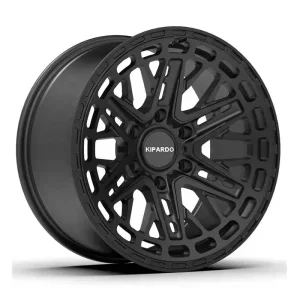
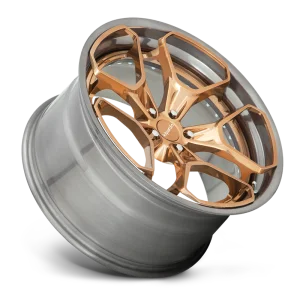
Direct factory configurations manufactured via 10,000-ton forging presses and aerospace-grade A356.2 low-pressure casting architectures.
Industry Evolution: The Shift from Billet Forging to Forged Carbon Hybrids
Analyzing structural physics, unsprung rotational mass dissipation, and metallurgical advances transforming the OEM tier and commercial aftermarket wheel engineering.
Forged Carbon & Composite Convergence
While traditional monoblock wheels rely on monolithic 6061-T6 aerospace aluminum, the next paradigm features hybrid architectures: high-modulus forged carbon fiber barrels married to high-tensile forged aluminum centers. This hybrid deployment yields a 40% reduction in rotational inertia, significantly increasing EV range and hypercar braking response.
Grain Flow Refinement via High Tonnage
In conventional casting, dendritic crystal structures produce microscopic porosity. Modern forging presses—applying between 8,000 to 12,000 metric tons of omnidirectional force—compress aluminum billets into strict radial grain patterns. Spoke roots and inner flanges achieve superior yield strengths surpassing 310 MPa, preventing stress fractures under severe lateral G-forces.
Electrification & Rotational Dynamics
Electric vehicles carry battery packs exceeding 500 kg, demanding payload wheel load ratings of 950 kg to 1,200 kg per corner. Simultaneously, low acoustic resonance and minimal aerodynamic drag are compulsory. Forged hybrid manufacturing permits razor-thin structural profiles and aerodynamic carbon covers without compromising ultimate payload resilience.
Global Enterprise Procurement Demands: Mitigating Risk & Total Cost of Ownership
Addressing the technical criteria automotive distributors, hypercar tuners, and Tier-1 procurement directors utilize to evaluate factory qualification.
Rigorous Dimensional Tolerancing (GD&T)
High-speed balance problems originate in minuscule hub eccentricities. Factory-grade CNC multi-axis milling protocols demand run-out tolerances under ≤ 0.30 mm for both radial and lateral axes, with center bore machining precision maintained within ± 0.02 mm to eliminate chassis harmonic vibrations.
Batch-Level Raw Material Traceability
Tier-1 purchasing agents require complete spectroscopic certificates for every melt heat lot. From virgin A356.2 aluminum to T6 heat-treated aerospace-grade 6061-T6 forgings, chemical composition must show strictly capped iron and silicon impurities to guarantee structural ductility and impact resistance.
Flexible Modular Tooling & Agile MOQs
While cast wheel pipelines enforce rigid mold amortizations (often 500+ units per mold), our custom forged wheel architecture facilitates on-demand 5-axis CNC programming. We enable custom PCD, ET, and back-pad pocketing configurations with flexible batch minimums starting at single vehicle sets (4 units).
Manufacturing Disciplines: Cast vs Flow-Formed vs Forged vs Carbon Hybrid
In-depth mechanical benchmark illustrating the trade-offs in yield tensile limits, thermal dissipation, mass reduction, and application criteria.
| Evaluation Parameter | A356.2 Low-Pressure Cast | Rotary Flow-Formed | Forged 6061-T6 Monoblock | Forged Carbon / Hybrid |
|---|---|---|---|---|
| Crystalline Grain Structure | Dendritic, Cast Non-Directional | Elongated, Compressed Rim Matrix | Continuous Dense Radial Grain | Omnidirectional Chopped Carbon / Billet Center |
| Tensile Yield Strength | ≈ 160 – 190 MPa | ≈ 220 – 250 MPa | ≈ 310 – 340 MPa | ≈ 450+ MPa (Composite Matrix) |
| Mass Delta (vs std. cast) | Baseline (100%) | -10% to -15% Reduction | -20% to -30% Reduction | -35% to -45% Reduction |
| Impact Resistance (13° Drop) | Complies with Standard JWL | High Flange Plasticity | Extreme Energy Absorption | Superior Fracture Energy Dissipation |
| Production Cycle & Tooling | High Tooling / Ultra-low Unit Cost | Moderate Tooling / Balanced Cost | No Steel Mold / High CNC Cycle | Precision Autoclave Tooling / Premium |
| Optimal Application Channel | Mass OEM Replica, Wholesale Retail | Track Enthusiast, High-Trim OEM | Supercars, Armored Limousines, Racing | Hypercars, Bespoke Performance, Range EVs |
Global Compliance Architecture: JWL, VIA, TÜV & SAE J2530
Our manufacturing floor is underpinned by complete in-line non-destructive inspection (NDI) and accredited structural test facilities.
Dynamic Cornering & Radial Fatigue
Wheel samples undergo rigorous bench validation enduring over 100,000 cycles under simulated high-speed bending moments without structural cracking or bolt loosening, adhering strictly to VIA and SAE J2530 dynamic standards.
13-Degree Striker Impact Validation
Curb collision safety is calibrated by dropped steel weights targeting the outer rim flange at 13°. Verified structural designs ensure zero instantaneous air loss, zero hub deformation, and immediate energy dispersion across the wheel spoke root system.
Electrochemical & Salt-Spray Resistance
Advanced multi-stage powder coat, anodized, and clear-coat surfaces are tested within automated CASS chambers for over 1,000 continuous hours. This prevents filiform corrosion, oxidative blistering, and degradation caused by road de-icing salts or marine air.
Engineering Roadmap: Toward Mass-Produced Forged Carbon Wheel Structures
Translating high-performance hypercar composite manufacturing into scalable industrial programs for the global aftermarket.
6061-T6 Precision Engineering
Standardized 8,000–10,000T forged blanks, bespoke multi-piece (2-piece and 3-piece modular designs), and fully automated CNC lightening back-pad machining.
Hybrid Forged Carbon Barrels
Thermoplastic resin infusion matching chopped forged carbon barrels to modular forged aluminum face centers using titanium assembly bolts, reducing barrel mass by 35%.
High-Volume RTM One-Piece Composites
High-pressure Resin Transfer Molding (HP-RTM) coupled with AI-driven generative topology optimization to mass-manufacture full carbon monoblock wheels under 7-minute cycle times.
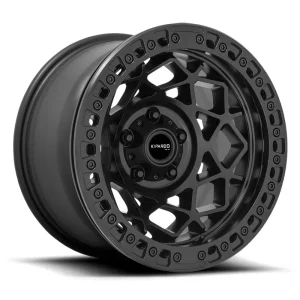
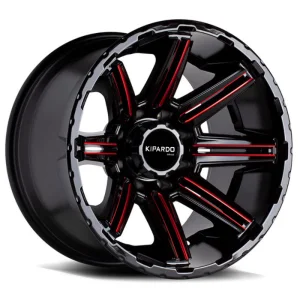
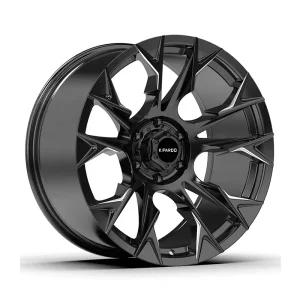
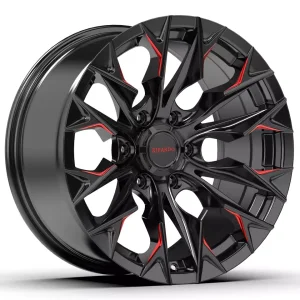
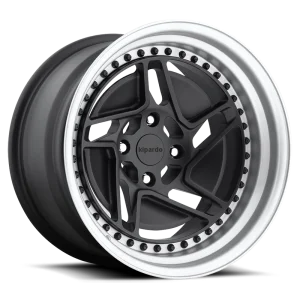
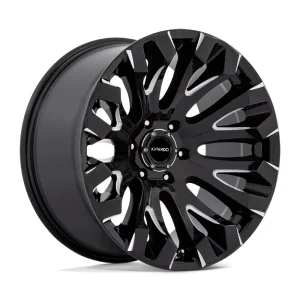
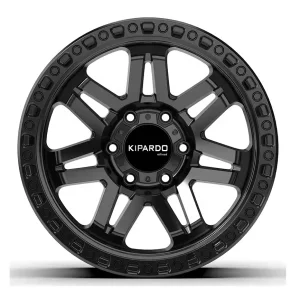
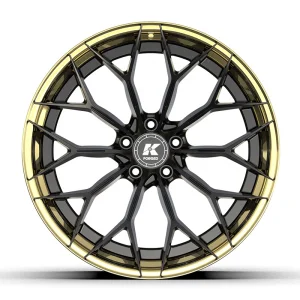
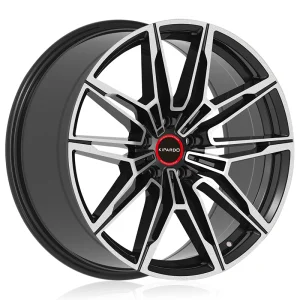
Industrial Custom Off-Road & Forged Wheels
Engineered for extreme axle payloads, aggressive off-road terrains, and luxury performance vehicle fitments.

Technical & Strategic FAQ for Commercial Buyers
Answers to common structural, metallurgy, logistics, and private-labeling questions encountered during the procurement cycle.