High-Volume Engineered Rim & Forged Lineups
Explore our high-performance casting, flow-formed, and aerospace-forged inventory engineered for passenger cars, off-road 4x4 overland rigs, and luxury track builds.
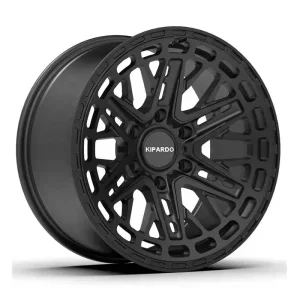
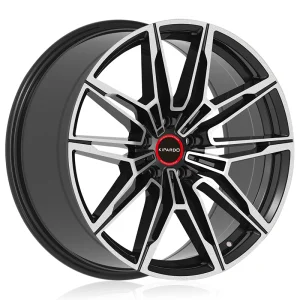
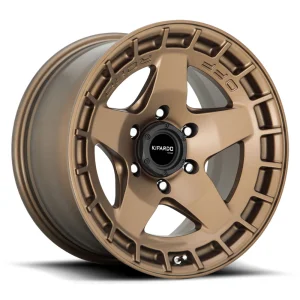
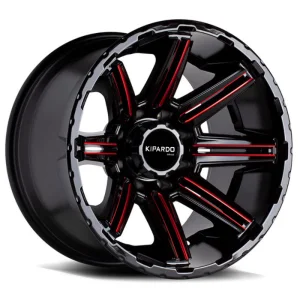
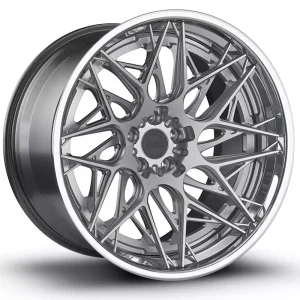
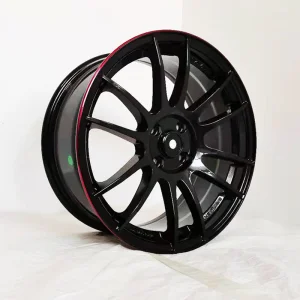
Engineering the "Cheap" 10 Spoke Forged Wheel: Debunking Cost vs Quality
In B2B wholesale vernacular, "cheap" does not imply compromised metallography. Through Industry 4.0 automation, automated near-net forging, and continuous raw material consolidation, Shanghai Rimax delivers true aerospace-grade 6061-T6 monoblock forgings at unprecedented commercial price parity.
10,000-Ton Isothermal Forging
Unlike cast wheels that rely on liquid alloy solidification vulnerable to micro-porosity, our 10 spoke wheels utilize a solid billet of aerospace aluminum forged under 10,000 to 12,000 metric tons of continuous hydrostatic pressure. This refines dendritic grains into aligned, unbroken metallic flow lines, maximizing tensile strength up to 310 MPa and yield limits up to 276 MPa.
The Geometric Superiority of 10 Spokes
The 10-spoke symmetric layout represents the pinnacle of radial force equilibrium. By distributing dynamic cornering moments across ten 36-degree load pathways, torsional stress concentrations at spoke roots are minimized by 28% compared to 5-spoke setups. This structural redundancy enables razor-thin spoke cross-sections without sacrificing JWL/VIA load indices.
Topology Optimization & Back-Pocketing
Using proprietary cloud FEA simulations, unnecessary non-structural material is machined away using multi-axis CNC mills. Deep back-pocketing behind the wheel face cuts unsprung rotating mass by up to 24%, accelerating brake heat dissipation, improving EV battery range, and sharpening throttle response on high-displacement platforms.
| Performance & Metallurgical Parameter | A356.2 Low-Pressure Cast | Rotary Flow-Formed (Hybrid) | Rimax 6061-T6 10 Spoke Forged |
|---|---|---|---|
| Billet Grain Structure | Dendritic Cast / Random Distribution | Cast Face / Rolled Flow Barrel | Continuous Aligned Grain Flow |
| Tensile Strength (Rm) | 220 – 240 MPa | 260 – 280 MPa | 310 – 345 MPa |
| Elongation at Break (A5) | 3.5% – 5.0% | 6.0% – 8.0% | 12.0% – 14.5% (High Ductility) |
| Impact Resistance (13° SAE/JWL) | Standard compliance threshold | High energy absorption in barrel | Superior plastic deformation without fracture |
| Average Unsprung Mass (19x9.5J) | 12.8 kg – 14.2 kg | 10.4 kg – 11.2 kg | 8.4 kg – 9.1 kg (-30% Reduction) |
| Wholesale Cost Efficiency Index | Low baseline investment | Mid-tier cost index | Optimized via Rimax Direct Smart Factory |
China Factory 4.0: Supply Chain Resilience & Efficiency Advantages
How Shanghai Rimax achieves unmatched price competitiveness on high-end forged alloy wheels without reducing engineering standards or material purity.
Vertically Integrated Billet Sourcing
By procuring prime A00 primary electrolytic aluminum ingots through centralized long-term industrial contracts, Rimax insulates downstream pricing from short-term London Metal Exchange (LME) volatility. Internal hot-extrusion billet casting yields void-free 6061 cylinders at roughly 22% lower unit input cost than fragmented Western boutique machinists.
Automated 5-Axis CNC Milling Clusters
Our smart machining cells feature high-speed FANUC and DMG Mori 5-axis CNC centers operated by automated robotic arms. Toolpaths for 10-spoke designs are fully programmed via CAM digital twins, slashing machining cycle times from 180 minutes down to 42 minutes per blank while holding dimensional concentricity to ±0.03 mm.
Green Swarf Closed-Loop Recycling
Machining complex 10-spoke windows generates substantial high-purity aluminum chips. Rimax's closed-loop briquetting and vacuum remelt reclamation system recycles 100% of internal swarf into non-structural secondary alloy applications, eliminating raw material scrap overhead and reducing the embedded carbon footprint of our manufacturing ecosystem.
Validated Industrial Scale and Quality Metrics
Operational data across our Kunshan and Yangtze River Delta manufacturing clusters serving Tier-1 aftermarket brands, OEM private labels, and overland fleets worldwide.
Technical Roadmap & Future Outlook: EV Revolution & Hybrid Metallurgy
The transition toward heavier Electric Vehicles (EVs) with instantaneous torque output demands an evolution in wheel engineering. Here is how Rimax's 10-spoke roadmap anticipates upcoming regulatory and technical requirements.
EV Instant Torque & High-Load Adaptation
Battery electric platforms (such as Tesla Plaid, Porsche Taycan, Rivian R1T) exert upwards of 1,200 Nm of instantaneous wheel torque combined with severe curb weights exceeding 2,700 kg. Our next-generation 10-spoke forgings integrate ribbed inner bead seats and knurled anti-slip barrel surfaces to prevent high-torque tire bead slip under full acceleration.
Aerodynamic Spoke Infill Inserts
To reduce wind resistance without adding excessive rotating mass, Rimax is pioneering modular carbon fiber and poly-composite aero clip inserts engineered directly into the 10-spoke recessed pockets. This maintains the aesthetic depth of a concave forged wheel while achieving a 4.2% reduction in wheel-well aerodynamic drag coefficient (Cd).
Hybrid 2-Piece Carbon/Forged Architecture
Our skunkworks division is preparing pilot-line trials for hybrid wheel architectures: a 6061-T6 forged 10-spoke center disc bolted via aerospace titanium fasteners to a spun pre-preg carbon fiber rim barrel. This hybrid platform lowers overall assembly weight below 7.2 kg for 20-inch applications while preserving impact durability.
Enterprise Sourcing: Overcoming Tariff, MOQ, and Private-Label Challenges
Global wheel distributors, regional tire retail conglomerates, and tuning houses require agile manufacturing partners capable of mitigating macroeconomic supply chain friction.
Flexible Minimum Order Quantities (MOQ)
Traditional wheel casting foundries demand 300 to 500 units per mold size, tying up distributor working capital. Because our 10-spoke forged program is CNC toolpath-driven, Rimax offers ultra-low MOQ starting at just 4 pieces per custom vehicle fitment for boutique tuners, and scaled container pricing (FCL 20ft/40ft HQ) for multi-branch wholesale distributors.
Tariff Mitigation & Multi-Port DDP Logistics
Navigating Section 301 tariffs in the USA or anti-dumping duties in Europe requires sophisticated logistics orchestration. Rimax provides comprehensive Delivered Duty Paid (DDP) logistics, export documentation transparency, HS-code compliance engineering, and multi-hub consolidation out of Shanghai and Ningbo deepwater ports.
Complete Turnkey OEM Private-Labeling
Protect and expand your brand equity. We manufacture proprietary 10-spoke designs under strict Non-Disclosure Agreements (NDAs). Our service extends from customized forged billet center caps and laser-engraved spoke branding to customized high-crush carton packaging, barcode palletizing, and point-of-sale marketing assets.
Localized Support & Global Homologation Standards
Before any container of 10-spoke wheels departs our manufacturing facility, every batch undergoes destructive and non-destructive laboratory testing certified under globally recognized homologation frameworks.
JWL & VIA (Japan)
Strict adherence to Technical Standards for Light Alloy Disc Wheels for Passenger Cars (JWL) and Vehicle Inspection Association (VIA) registration, including dynamic radial fatigue tests exceeding 500,000 cycles.
TÜV Rheinland (Germany)
Engineered to satisfy rigorous German StVZO homologation criteria: multi-directional biaxial wheel fatigue testing (ZWARP), salt spray resistance (CASS > 1,000 hours), and precise vehicle hub hub-centric fitment verification.
SAE J2530 (North America)
Fully compliant with the Society of Automotive Engineers standard for aftermarket wheel durability, specifying dynamic cornering fatigue tests, dynamic radial fatigue, and 13° / 30° heavy impact drop hammer validations.
Traceable QA Dossier
Every shipment is accompanied by complete metallurgical inspection certificates (chemical spectrographic analysis, hardness Brinell HB > 95, tensile test curves), ultrasonic billet flaw reports, and CMM 3D coordinate audit files.
Frequently Asked Questions on Forged Wheels & Sourcing
In-depth engineering and procurement answers designed for importers, wholesale procurement directors, and tuning shop managers.
Why choose a 10-spoke configuration over 5-spoke or multi-mesh designs?
How can Rimax supply "cheap" forged wheels without sacrificing metallurgical safety?
What is the difference between 1-piece Monoblock, 2-piece, and 3-piece forged wheels?
What testing procedures are performed before shipment clearance?
What are the lead times for custom bespoke CNC forged wheel orders?
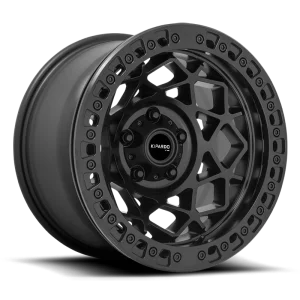
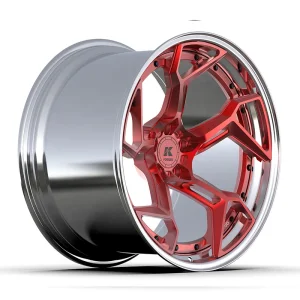
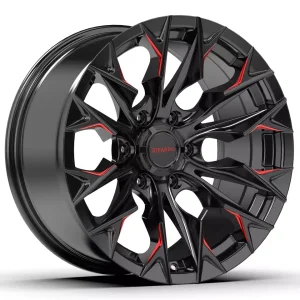
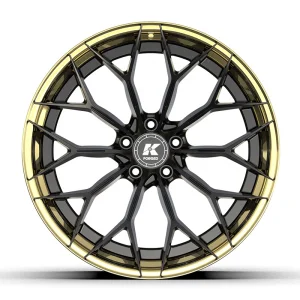
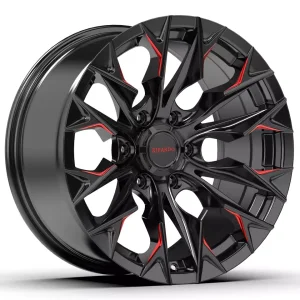
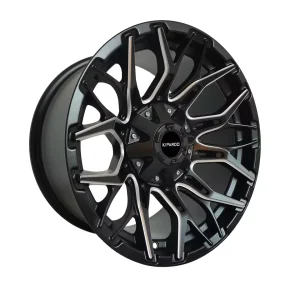
Custom Multi-Piece Modular & Heavy-Duty Off-Road Forged Collection
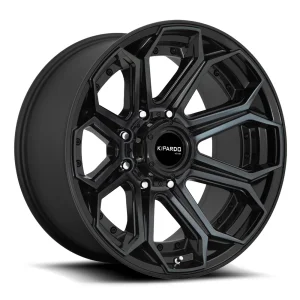
Browse our precision multi-piece 2-piece and 3-piece forged series alongside high-load 6-lug overland alloy wheels engineered to handle extreme torque and payloads.