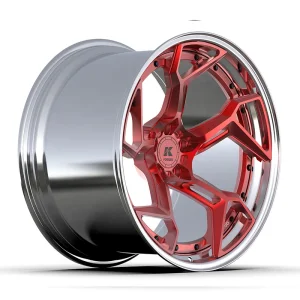
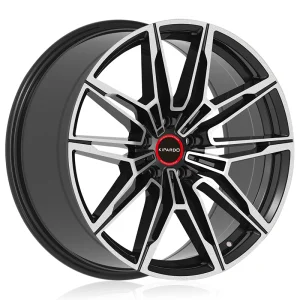
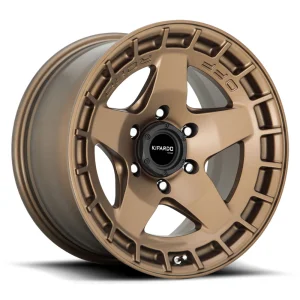
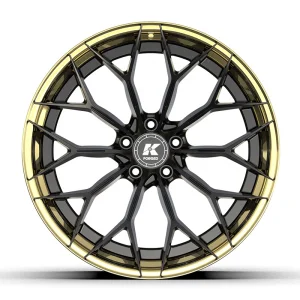
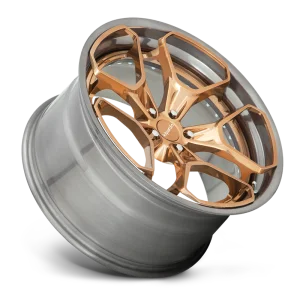
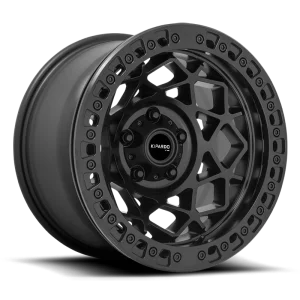
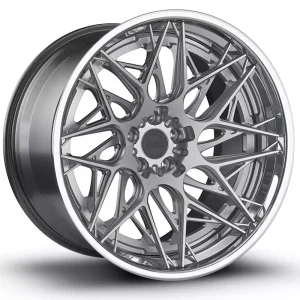
Featured Cast, Forged & Heavy-Duty Offroad Series
Factory-customized alloy configurations engineered to JWL, VIA, and SAE J2530 homologation standards for performance mobility.
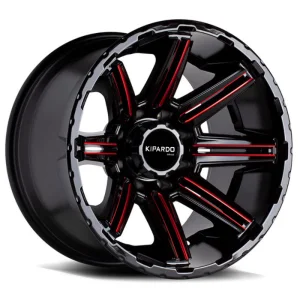
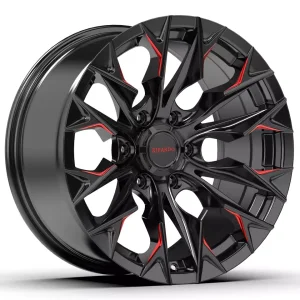
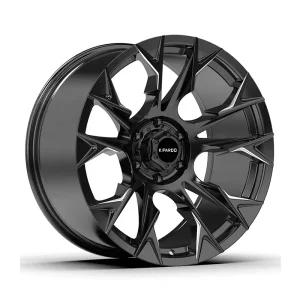
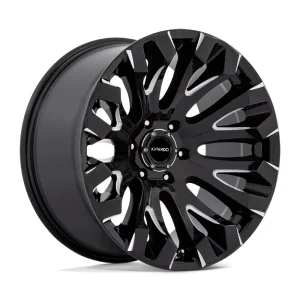
Monoblock Forging Architecture in Global Automotive Programs
Addressing the paradigm shift toward unsprung mass mitigation, extreme rotary fatigue management, and high-load commercial electric vehicle platforms.
Rotational Inertia & EV Dynamics
Electric vehicles carry higher static gross vehicle weights (GVW) accompanied by instant low-end torque profiles. Our monoblock forged wheels reduce rotational inertia by up to 28% compared to standard low-pressure cast wheels, substantially improving regenerative braking efficiency and extending battery operating range under WLTP verification cycles.
Grain Flow Alignment & Tensile Integrity
Utilizing 10,000-ton closed-die hydraulic forging presses, the metallurgical grain boundary structure of our 6061-T6 aluminum ingots is oriented continuously along the spoke and outer rim profiles. This eliminates internal micro-porosity, producing yield strengths exceeding 310 MPa and ultimate tensile strength above 350 MPa.
Generative Spoke Topology Optimization
Through integration of algorithmic Finite Element Analysis (FEA), spoke thickness and barrel back-pad pockets are structurally optimized. Metal is excised exclusively from non-load-bearing stress nodes, preserving structural rigidity under extreme lateral cornering stresses while removing critical grams of un-sprung wheel assembly mass.
Global OEM Commercial Positioning & Supply Chain Resilience
Navigating raw material supply stability, multi-axis manufacturing economics, and tariff mitigation strategies for Tier-1 and Tier-2 automotive procurement.
Billet Economics
Direct procurement of virgin aerospace-spec 6061 aerospace billets mitigates secondary scrap contamination. Strategic inventory stockpiling shields global distributor partners against volatile LME commodity fluctuations.
5-Axis CNC Milling
Equipped with Makino and DMG Mori multi-axis centers, our production corridors maintain spindle concentricity within 0.005mm tolerances, dramatically accelerating cycle times on bespoke concave and split-spoke OEM designs.
Tariff & Trade Redundancy
Structured shipping arrangements support dual-invoicing, multimodal bonded clearance, and tariff-compliant origin declarations to streamline entry across North America, Europe, Australia, and GCC economic zones.
Flexible Scale Batches
From rapid tooling runs of 4 bespoke center-lock race wheels to full 40-foot HQ container freight allocations for nationwide private-label wheel brands, manufacturing runs scale seamlessly without retooling lead delays.
Structural Benchmark: Monoblock Forged vs. Flow-Formed & Cast
Empirical mechanical attributes derived under standard automotive destructive laboratory protocol.
| Evaluation Parameter | OEM Monoblock Forged (6061-T6) | Flow-Forming Hybrid | Low-Pressure Cast (A356.2) |
|---|---|---|---|
| Precursor Material Base | Solid extruded 6061 aerospace cylinder | Cast A356 aluminum with spun rim | Molten primary A356.2 aluminum ingot |
| Yield Strength (Rp 0.2) | 310 – 340 MPa | 210 – 245 MPa (barrel only) | 160 – 190 MPa |
| Ultimate Tensile Strength (Rm) | 350 – 380 MPa | 280 – 310 MPa | 230 – 260 MPa |
| Grain Density & Porosity | Zero microscopic voids; linear grain flow | Dense barrel; micro-voids in center hub | Dispersed dendritic porosity risk |
| Typical Weight Ratio (20x9.5J) | ~9.8 kg – 10.4 kg (Baseline -28%) | ~11.5 kg – 12.2 kg (-12%) | ~13.8 kg – 15.0 kg (Baseline) |
| Impact Resistance (13° SAE/JWL) | Ductile deformation without fracturing | Elastic barrel, moderate spoke fracture risk | Brittleness risk under severe shock loading |
| Production Application Scope | Bespoke Hypercars, Track, Armor, Luxury EV | Mid-tier Enthusiast, Commercial Tuning | Mass Wholesale, High-volume OE Replacement |
Targeted Engineering Implementations Across High-Stress Arenas
Tailoring PCD configurations, offset offsets (ET), backpad clearances, and payload thresholds to extreme deployment criteria.
Heavy-Duty 4x4 Overland & Armored Platforms
Demanding load ratings upward of 1,250 kg to 1,600 kg per wheel corner. Our reinforced bead seats, increased spoke cross-sectional thickness, and knurled anti-slip inner barrels resist high-torque tire slipping during low-pressure rock crawling and tactical vehicle offroad maneuvers.
High-Performance EV & Hybrid Hypercars
Aerodynamically sculpted monoblock designs tailored to channel cooling air directly toward massive carbon-ceramic brake calipers while managing drag coefficients. Custom center-lock and 5-lug bolt hubs ensure zero rotational wobble at track speeds exceeding 320 km/h.
Ultra-Luxury Concave & Bespoke Styling
Deep concave spoke architectures featuring multi-axis pocketing, brushed titanium, polished machine face, and durable PVD candy color coatings. Tailor-engineered offsets clear oversized Brembo/Akebono big brake kits without requiring hub-centric wheel spacers.
Comprehensive Quality Assurance & Destructive Verification
Meeting and surpassing stringent international homologies: JWL, VIA, SAE J2530, and TÜV Rheinland certifications.
Dynamic Cornering Test
Subjugating the wheel hub and spoke roots to high continuous bending moments exceeding 100,000 revolutions under 1.5x designated axle loads to ensure complete resistance to fatigue micro-fissuring.
13° & 30° Impact Test
Free-falling wedge striker drops simulate curbside impacts and high-speed road debris collisions. Monoblock wheel rim flanges absorb energy through controlled ductility without explosive air depressurization.
Spectrometry & X-Ray
100% inline non-destructive radiography screens raw billets and machined hubs for internal density anomalies. Optical emission spectrometers confirm alloy purity matches exact 6061 and A356.2 chemical proportions.
CASS Salt-Spray Chamber
Subjected to over 1,000 continuous hours of copper-accelerated acetic acid salt spray (CASS) exposure, verifying that powder coatings, clear gloss, and diamond-machined clearcoats resist blistering in corrosive winter salt environments.
Technological Trajectory: Next-Gen Monoblock Manufacturing
Pioneering sustainable metallurgical cycles, AI-driven topology modeling, and hybrid composite-alloy integration.
12,000-Ton Isothermal Forging
Transitioning from conventional mechanical forging to isothermal hydraulic presses that maintain billet temperature during compression, enabling ultra-thin spoke cross-sections without sacrificing localized fatigue limits.
Hybrid Carbon-Alloy Architecture
Integrating a 6061-T6 forged center monoblock star hub with a resin-infused dry carbon fiber outer barrel, shedding an additional 35% of rim perimeter mass for extreme motorsport and hypercar response.
Closed-Loop Green Aluminum Smelting
Implementing certified low-carbon aluminum smelted with 100% hydroelectric energy. Internal CNC swarf is vacuum-recompacted and melted in inert nitrogen atmospheres to achieve net-zero manufacturing footprint goals by 2030.
Frequently Asked Technical & Commercial Questions
Authoritative guidance for automotive brand managers, commercial buyers, and industrial wheel importers.
Concave Forged, Luxury Multi-Piece & Certified Vehicle Fitments
Explore our full line of luxury, commercial, and high-performance forged and flow-formed systems.