
Engineered Fleet Rim Platforms & Forged Line-Haul Assemblies
Explore heavy-duty, multi-piece, and precision monoblock forged truck wheel configurations engineered directly at Shanghai Rimax Industry Co., Ltd. and the Kipardo industrial production complex.
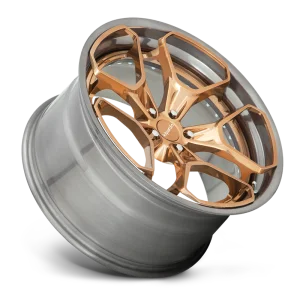
OEM Kipardo alloy wheels Forged car 3 pieces forged wheels 2 pieces,monoblock Manufacturer, Products
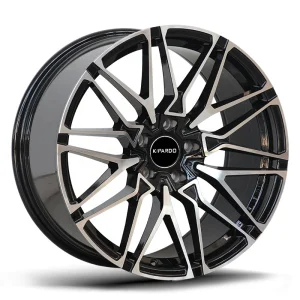
Custom Kipardo 19 20 21 22 inch factory custom wholesale luxury alloy rims aluminum 4x4 offroad wheels Exporter, Service
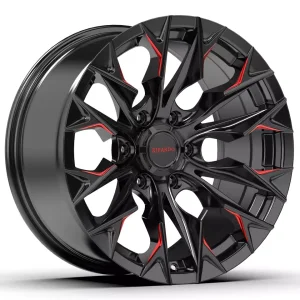
Cheap Kipardo 16 17 18 inch 6 hole custom casting car aluminum alloy rims 4x4 offroad wheels Exporters, Service
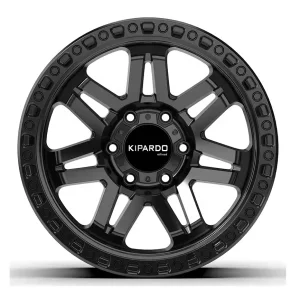
China Kipardo 17 18 inch factory wholesale 6 hole custom car aluminum alloy rims 4x4 offroad wheels Supplier, Service
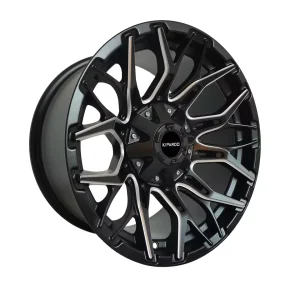
Cheap Kipardo 17 18 inch 5 6 hole factory custom casting car aluminum alloy rims 4x4 off road wheels Exporter, Product
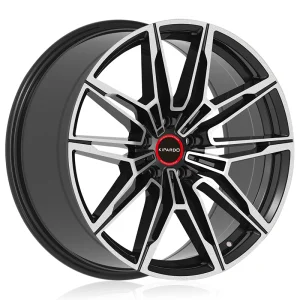
China Kipardo 18 19 20 inch factory wholesale cast alloy rims aluminum 4x4 offroad wheels Manufacturers, Suppliers
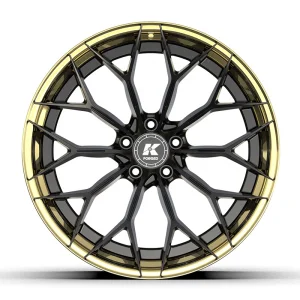
OEM Kipardo Luxury forged wheels 3 Pieces forged Rims Manufacturers, Companies

CE Certification Kipardo 17 20 inch 6lug 6x139.7 4x4 offroad car alloy wheels rims for lexus GX460 GX470 Company, Products
Global Commercial Dynamics of Forged Truck Wheels
A comprehensive examination of how shifting logistics models, axle payload mandates, and fleet carbon accounting are driving massive migration from stamped steel to forged aluminum rim assemblies.
The Global Fleet Paradigm Shift
Worldwide commercial transport networks across North America, the European Union, Australia, and East Asia are experiencing a structural shift toward forged aluminum rims. Traditionally dominated by heavy welded steel wheels due to low upfront purchase pricing, Class 6, 7, and 8 line-haul operations now prioritize Total Lifecycle Economics. Rising fuel costs and strict weight enforcement checkpoints make every saved kilogram directly convertible into revenue payload.
Supply Chain Reconfiguration
Global truck manufacturers (OEMs) and national distributors face tightening supply bottlenecks for raw forged billets. Modern production hubs centered in Jiangsu, China—anchored by facilities such as Shanghai Rimax Industry Co., Ltd. (operating since 2010)—deliver fully certified JWL and VIA compliant forgings. This direct-from-factory structure allows overseas distributors to bypass intermediaries, drastically mitigating geopolitical shipping risks.
ESG & Corporate Carbon Offsetting
With Scope 1 and Scope 3 greenhouse gas reporting requirements enacted by regulatory agencies worldwide, fleet operators utilize aluminum wheel conversions to directly reduce fleet carbon emissions. Aluminum retains over 95% of its structural metallurgical value through closed-loop remelting, establishing high residual salvage values that dramatically outperform degraded scrap steel rims.
Material Science: 6061-T6 Grain Alignment vs. Porosity
Why forged monoblock structures eliminate catastrophic rim fractures across heavy-haul applications under extreme lateral torque and high ambient operating temperatures.
Microstructural Grain Flow Integrity
Cast aluminum wheels (A356.2 alloy) solidify from liquid molten metal within a mold cavity. Despite advanced low-pressure casting and degassing protocols, cast wheels inherently retain micro-porosity, dendrite boundaries, and localized cooling variations. When subjected to continuous cyclical stress—such as a loaded semi-truck navigating high-speed interstate banking—these micro-cavities act as stress concentration nodes where fatigue micro-cracks originate.
In stark contrast, 6061-T6 solid billet forging utilizes a massive 8,000-to-10,000-ton hydraulic forging press. The solid aluminum cylindrical billet is subjected to extreme multi-directional hydrostatic compression. This deformation breaks up dendritic coarse grains, recrystallizing the aluminum into a continuous, tightly packed molecular grain boundary that flows uninterrupted along the spoke contour and rim flange.
Thermal Dissipation & Braking Efficiency
Forged 6061 aluminum features thermal conductivity of approximately 167 W/m·K, nearly three times greater than structural steel (~50 W/m·K). In heavy commercial hauling, frequent descent braking transforms kinetic energy into extreme disc brake temperatures exceeding 500°C.
Forged aluminum rims act as substantial conductive heat sinks, drawing thermal energy rapidly away from the brake rotors, wheel hub bearings, and tire bead assemblies. This reduces tire blowouts caused by bead scorching by up to 42%, while simultaneously extending brake pad service intervals and preventing bearing grease liquefaction.
| Technical Characteristic | Heavy-Duty Forged 6061-T6 | Flow-Formed Aluminum Rim | Standard Stamped Steel Wheel |
|---|---|---|---|
| Manufacturing Process | 10,000-Ton Hydraulic Forging + Heat Treat + CNC | Low-Pressure Cast Center + Spun Rolled Barrel | Hot Rolled Disc + Cold Rolled Welded Rim |
| Tensile Strength (Ultimate) | ≥ 310 - 340 MPa | ≥ 240 - 270 MPa | ≥ 400 - 450 MPa |
| Yield Strength (Rp 0.2) | ≥ 275 - 295 MPa | ≥ 175 - 200 MPa | ≥ 240 - 280 MPa |
| Tare Weight (22.5" x 8.25") | 22 - 25 kg (Optimal Tare) | 28 - 31 kg | 38 - 46 kg (Heavy) |
| Elongation at Break (δ5) | 12% - 15% (Superior ductility) | 8% - 11% | 18% - 22% |
| Fatigue Resistance Cycles | > 1,000,000+ Cycles (JWL-T passed) | > 500,000 Cycles | > 350,000 Cycles |
| Corrosion Resistance | High (Natural passivation + Anodizing) | Moderate (Dependent on surface coating) | Low (Prone to rust at weld joints) |
Emerging Macro Trends Across the Wheel Industry
How the commercial vehicle electrification revolution, aerodynamic aero-covers, and predictive sensor suites are modernizing the heavy forged rim ecosystem.
BEV Truck Range Maximization
Battery Electric Commercial Vehicles (BEVs), such as Class 8 electric tractors, carry enormous battery pack tare weights ranging from 3,000 to 5,500 kg. This deadweight substantially degrades cargo payload capacity. By equipping an 18-wheel tractor-trailer with forged 6061-T6 wheels instead of steel rims, fleets recover up to 550 kg of legal payload capacity while reducing rotational un-sprung mass, boosting battery driving range per charge cycle by 3.8%.
Aerodynamic CNC Surface Sculpting
Aerodynamic resistance around spinning wheels accounts for roughly 12% to 15% of total highway aerodynamic drag on tractor-trailer units. Modern high-precision 5-axis CNC machining centers sculpt forged rims with smooth aero-optimized contours, integrated valve pocket recesses, and flush flange transitions that streamline airflow along the chassis skirt, saving hundreds of liters of diesel annually per truck.
Integrated Smart Fleet IoT & TPMS
The convergence of telematics and hardware has produced forged truck rims engineered with dedicated internal recess chambers to house secure, vibration-damped TPMS (Tire Pressure Monitoring System) sensor modules. Real-time telemetry monitoring internal rim temperature and air pressure transmits directly to cloud fleet management software, alerting dispatchers before a slow leak causes tire delamination.
Localized Real-World Deployment Scenarios
Analyzing duty-cycle demands: from sub-zero highway long-hauling in Scandinavia to high-impact articulated mining tippers in the Australian Outback.
Interstate Long-Haul Logistics
Overland freighters logging 180,000 to 250,000 km annually across high-speed motorways. Priority: Weight savings, perfectly balanced rotational un-sprung mass, fuel conservation, and run-out accuracy (<0.3mm) to eliminate cabin vibration and driver fatigue.
Severe Mining & Quarries
Heavy dumpers, concrete mixers, and articulated haulers traversing rocky, unpaved off-highway terrain. Priority: High yield strength and impact resistance (13° drop test validation) to prevent rim lip fracturing under continuous 50-ton aggregate loads.
Sub-Zero Nordic & Arctic Routes
Winter freight transiting roads heavily treated with magnesium chloride, rock salt, and brine. Priority: Corrosion passivation treatments, specialized acrylic powder clearcoats, and zero embrittlement at operational temperatures dropping to -45°C.
Urban Delivery & Transit Fleets
Buses and local delivery vehicles subject to continuous stop-and-go acceleration cycles, frequent curb scraping, and heavy brake friction heat. Priority: Forged reinforced outer flanges with curb-guard rings and rapid heat dissipation.
Factory Metrology & International Validation Protocols
The manufacturing blueprint: how Rimax and Kipardo engineering teams guarantee defect-free structural safety across millions of cumulative operational fleet kilometers.
Radial Fatigue Stress Validation
Wheels undergo relentless continuous radial drum testing conforming to JWL-T (Japan) and SAE J267 (USA) standards. A designated tire mounted to the forged rim is pressed against a revolving steel drum driven under 2.25 times the rated gross axle weight rating (GAWR) for over 1,000,000 cycles, verifying that zero structural micro-cracking or pressure loss occurs.
Dynamic 90° Cornering Bending
Simulating extreme lateral g-forces during emergency avoidance maneuvers or sharp mountain descents. The wheel hub is bolted to a rotating eccentric arm applying cyclic bending moments calculated per ISO 3006 requirements. Forged rims demonstrate zero plastic deformation or fastener seat loosening across more than 150,000 bending cycles.
13° Calibrated Striker Impact Test
A heavy structural steel wedge striker drops freely from a calculated height directly onto the critical junction between the rim flange and spoke root. Forged 6061-T6 aluminum absorbs the sudden kinetic energy through minor elastic deformation without catastrophic brittle cracking or instant depressurization, ensuring vehicle control.
Heavy Duty Off-Road & Monoblock Custom Billet Series
Review additional commercial truck, off-road overland, and customized multi-bolt forged aluminum configurations available for global volume procurement and OEM private-label branding.
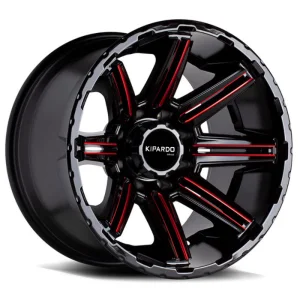
Wholesale Kipardo 17 18 inch factory customized aluminum alloy car rims offroad wheels Suppliers, Factories
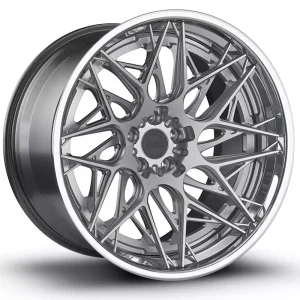
Discount Kipardo 18 inch to 24 inch fully custom 6061-T6 aluminum concave forged wheels Suppliers, Company
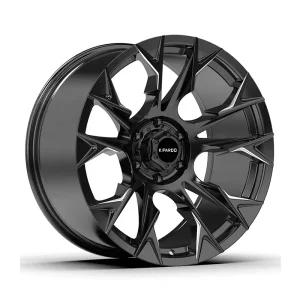
Custom Kipardo 20 inch factory wholesale 5 6 hole aluminum alloy rims 4x4 offroad wheels Supplier, Companies
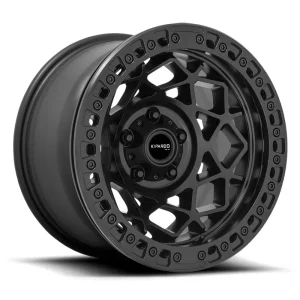
ODM Kipardo 17 20 inch factory wholesale black custom cast aluminum alloy rims 4x4 offroad wheels Manufacturer, Products
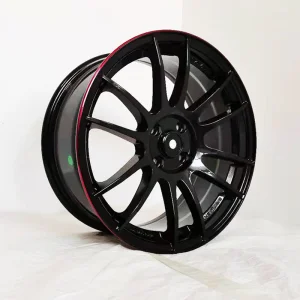
Cheap KIPARDO 15 inch 5x100 undercut red new japan design wheel Quotes, Products
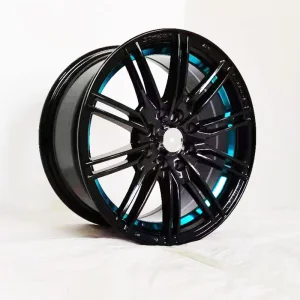
Wholesale KIPARDO 15 inch black color machine face alloy wheel rims for sale Manufacturer, Quotes
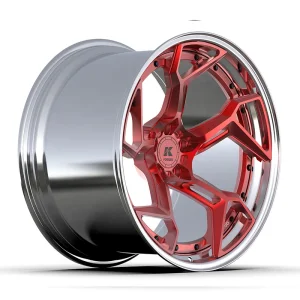
OEM Kipardo Custom 18 19 20 21 22 inch 6061-T6 aluminum concave forged wheels Suppliers, Exporter
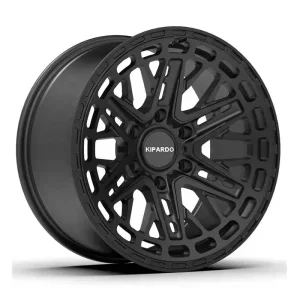
Wholesale Kipardo China factory 20 inch 5 6 hole alloy rims aluminum 4x4 offroad wheels Supplier, Factories
Commercial Fleet TCO Modeling: The ROI Equation
A rigorous quantitative breakdown illustrating how purchasing forged aluminum rims generates a rapid positive return on capital investment across medium and heavy freight operations.
Direct Fuel & Energy Savings
Rotating mass requires roughly twice the kinetic energy to accelerate compared to static chassis weight. Lightening each wheel position by ~22 kg across an 18-wheel tractor-trailer yields an overall rotating mass reduction of approximately 396 kg. Empirical fleet road tests show this rotational inertia reduction cuts stop-and-go fuel consumption by 2.5% to 3.2%, translating to over $1,800 USD in annualized diesel fuel savings per long-haul tractor.
Payload Freight Revenue Uplift
For bulk-liquid haulers, dry bulk tankers, aggregate tippers, and reefer transports operating at maximum gross vehicle weight (GVW) legal limits (e.g., 80,000 lbs in the US or 44 tonnes in the EU), every pound saved on running gear directly increases billable freight weight. At an average freight tariff of $0.05 to $0.08 per ton-mile, shedding 396 kg yields between $2,400 and $3,800 USD in incremental net revenue per equipment unit each fiscal year.
Maintenance Elimination & Salvage
Steel wheels require periodic bead blasting, rust grinding, anti-corrosion priming, and repainting every two to three years to avoid rust-jacking and rim-lip failure, incurring steady workshop labor overhead. Forged aluminum rims are impervious to rust and come protected with Kipardo's 5-year / 100,000 km structural warranty. Upon fleet decommission, forged rims retain an aluminum scrap commodity value up to 10 times higher than rusted steel.
Engineering Roadmap: Next-Decade Truck Wheel Technologies
A technical forecast into the metallurgical innovations, additive hybrid tooling, and AI-driven quality assurance processes emerging across advanced wheel manufacturing facilities.
12,000-Ton Isothermal Forging
The next iteration of heavy commercial wheel tooling utilizes isothermal die chambers where die faces are pre-heated to matching billet temperatures. This eliminates thermal gradient chilling during forging, allowing thinner web spoke profiles with unprecedented fatigue strength, driving single-wheel weights below 20 kg for 22.5" fitments.
AI Computer Vision Flaw Detection
Replacing manual sampling with in-line computed tomography (CT) scanning paired with convolutional neural networks (CNNs). Every forged rim passing through CNC machining lines is scanned in three dimensions within seconds, catching subcutaneous inclusions or machining deviations smaller than 50 microns.
Self-Passivating Ceramic Coatings
Nanostructured ceramic silane treatments baked at 220°C create a permanent covalent bond with the aluminum substrate. The resulting ultra-hard surface resists rock chipping, brake dust embedding, and corrosive brine chemical attacks, eliminating manual wheel acid polishing procedures.
Frequently Asked Questions: Global Sourcing & Engineering
Authoritative technical answers to common queries submitted by fleet superintendents, tier-1 wholesale distributors, and commercial truck chassis engineers.
What are the exact metallurgical advantages of 6061-T6 forged rims over cast steel wheels?
Which testing certifications are mandatory for importing commercial truck wheels into North America and Europe?
What standard sizing configurations and bolt patterns (PCD) do your factories manufacture?
- 22.5" x 8.25" & 22.5" x 9.00": Standard line-haul Class 8 steer, drive, and trailer wheels (10x285.75mm PCD, 281mm center bore; 10x335mm PCD, 281mm CB).
- 22.5" x 11.75" & 22.5" x 14.00": Wide-base super single configurations for weight-sensitive aggregate and tanker fleets (0mm, 56mm, and 120mm offsets).
- 19.5" x 7.50" & 17.5" x 6.75": Medium-duty delivery vans, low-bed heavy transport trailers, and transit municipal buses (8x275mm and 6x205mm PCD).
- Custom Off-Road & Luxury 4x4: 17" to 24" bespoke 5-lug, 6-lug (6x139.7), and 8-lug (8x165.1 / 8x170 / 8x180) configurations machined to OEM and aftermarket specifications.