Flagship Engineering & Wheel Systems
Explore precision-tested performance assemblies, CNC-machined wheel suites, and modular hub interface foundations engineered for competitive paddock and tier-1 distributor channels.
Evolving Paradigms in Race Car Setup & Metrology
Dynamic trackside alignment and kinematic verification demand CE-certified structural integrity, replacing conventional scales with integrated, ball-bearing hub stand platforms.
Kinematic Precision & Scrub Elimination
Traditional roll-on scales induce compliance errors and tire sidewall scrubbing during camber and toe adjustments. Next-generation race car hub stands eliminate tire deflection entirely, transferring vehicle corner weight directly from the upright onto precision-machined, multi-directional low-friction roller bearings for 0.01mm repeatability.
Aviation-Grade 6061-T6 Monoblock Billets
With motorsport downforce values surpassing 1,500 kg at high velocity, hub rigs must withstand massive asymmetric dynamic loads. Our fabrication utilizes finite-element-analyzed 6061-T6 and 7075 structural alloys, undergoing aerospace thermal stabilization to guarantee zero chassis-warp tolerance under maximum pre-load conditions.
Stringent CE Directives & Safety Compliance
European and North American workshops require verified occupational workshop compliance. CE Machinery Directive (2006/42/EC) qualification ensures our structural hub stands, integrated leveling pucks, and pneumatic locking pins deliver fail-safe reliability during full-crew setup, bump-steer mapping, and live damper tuning.
Enterprise Sourcing: Engineering Specifications & Quality Mandates
Professional racing teams, OEM tuning houses, and distribution networks demand traceable structural metallurgy and adaptable bolt-circle modularity across GT3, TCR, and formula categories.
Universal Multi-PCD Indexing
Global fleets run varied pitch circle diameters (4x100, 5x114.3, 5x120, 5x130, center-lock). Sourcing targets modular swappable plates machined to within ±0.005mm of true position.
Certified Traceable Metallurgy
B2B contracts require full EN 10204 3.1 chemical and physical test certificates for every production batch, ensuring total absence of internal structural porosity and uniform load endurance.
Turnkey Paddock Modular Kits
Commercial racing operations require complete kits: heavy-duty flight cases, digital leveling bases, high-accuracy string line frames, and electronic load cell interfaces in one cohesive system.
OEM & White-Label Capability
Performance engineering brands require tailored anodized colorways, laser-etched alignment gradients, and bespoke center bore locator rings matching proprietary racing upright designs.
Integrated Engineering Solutions for Professional Motorsport
Combining heavy-duty hub stands, precision cast and forged wheels, and digitized setup arrays for world-class trackside consistency.
Hub-to-Corner Weight Balance Alignment
By seating the car directly onto electronic load cells housed inside our low-profile hub stand base, teams eliminate corner-weight offsets caused by tire pressure fluctuation, bead seating shifts, or carcass temperature variations. Live camber and toe changes are recorded without jacking up the chassis.
CAD-Engineered Suspension Kinematic Verification
Equipped with laser-etched vernier scales and magnetic digital angle gauges, our factory hub systems enable real-time bump-steer curve tracing, roll-center optimization, and anti-dive/anti-squat angle verification right on the pit apron or setup pad, cutting trackside setup time by up to 65%.
Complete Chassis & Wheel Integration Infrastructure
Pairing CE-certified hub stand arrays with our JWL/VIA-verified casting, flow-formed, and custom forged wheel assemblies provides racing operations and custom builders with an unbroken chain of precision. From factory-floor alloy melt chemistry to pit-lane wheel torque-up, Rimax delivers structural consistency across global motorsport networks.
Engineering Specifications: Hub Stands vs. Traditional Systems
A rigorous benchmark demonstrating structural performance, metrology accuracy, and occupational safety parameters.
| Evaluation Parameter | CE Certified Billet Hub Stands | Standard Roll-on Turnplates | Hydraulic Alignment Racks |
|---|---|---|---|
| Load Rating Per Corner | 1,250 kg – 2,500 kg (Certified 4x Safety Factor) | 500 kg – 800 kg (Unverified) | 800 kg – 1,200 kg (Fixed Installation) |
| Scrub Friction Mechanism | Multi-directional stainless steel roller bearings | Teflon sliding plates (Degrades under heat/debris) | Pneumatic slip plates (High resistance) |
| Toe & Camber Measurement Tolerances | ±0.02° Camber / ±0.1mm Toe Repeatability | ±0.25° Camber (Influenced by tire crown) | ±0.15° Camber (Suspension binding present) |
| Chassis Access & Damper Clearance | 100% Full Access: Uprights, Coilovers & Wishbones | Restricted by wheel rim and tire sidewall | Partially restricted by lift runways |
| Compliance Certification | CE Machinery Directive 2006/42/EC + EN 13155 | Generally Non-Certified Consumer Tier | Regional Workshop Safety Certifications |
| Transportability & Paddock Mobility | Heavy-duty modular flight case (Air freight ready) | Bulky, awkward multi-piece floor units | Stationary floor-mounted structure |
Global Compliance, Warranty & On-Site Support
Shanghai Rimax Industry Co., Ltd. provides verified quality assurance, comprehensive test certifications, and dependable supply chain logistics across Europe, the Americas, and the Asia-Pacific.
5-Year Structural Integrity Warranty
Every Kipardo wheel and industrial racing hub stand undergoes ultrasonic flaw detection and coordinate-measuring machine (CMM) verification, backed by a 5-year structural warranty and full traceability from billet casting to export pallet dispatch.
Full CE & JWL/VIA Documentation
We provide full technical documentation for importers, including CE certificates of conformity, finite element analysis (FEA) reports, 13° impact testing records, radial fatigue data, and material mill sheets required for rapid local customs clearance.
Global B2B Supply & Engineering Support
Our engineering support team in Kunshan, Jiangsu provides personalized technical consultation for specialized PCD development, bespoke paddock setups, center-lock adapters, and mixed-container consolidated maritime logistics.
Technical Roadmap: Wireless Sensor Integration & AI Setup
The transition from mechanical alignment to digital telemetry: how next-generation hub stand platforms integrate real-time kinematics directly with cloud simulation.
Phase 1: Wireless Bluetooth Load Cells
Integrating miniature load cells and digital inclinometers directly into the hub base plates, communicating live 4-wheel corner balance and geometry data to race engineer tablets via secure telemetry protocols.
Phase 2: Automated Chassis Kinematic Solvers
Pairing real-time hub stand deflection inputs with cloud-based multi-body dynamic solvers to instantly project chassis roll-center migration, anti-geometry shifts, and tire contact-patch pressure distributions.
Phase 3: Hybrid Carbon-Alloy Structural Composite Stems
Researching ultra-high modulus continuous carbon-fiber upright upright stems bound with 6061-T6 aluminum matrix bases, achieving a 40% weight reduction while increasing rigidity against deflection during high-load damper stroke tests.
Race Car Hub Stands & Wheel Manufacturing FAQ
Comprehensive answers regarding CE certification standards, hub stand load ratings, modular fitments, and supply chain timelines.
Why is CE Certification essential for race car hub stands?
CE Certification confirms compliance with the European Machinery Directive (2006/42/EC). It validates that the hub stands have undergone structural FEA simulations, static and dynamic proof-load testing at a minimum 4x safety factor, and meet all operator safety standards for professional pit-lane and workshop operations.
How do hub stands deliver higher precision than alignment wheels?
Alignment on wheels is inherently vulnerable to tire pressure changes, sidewall runout, tread variance, and lateral tire scrub on turnplates. Hub stands mount directly to the wheel studs, utilizing integrated ball-bearing roller bases that freely absorb suspension track-width changes during adjustments, providing repeatable 0.01mm toe and 0.02° camber measurements.
Can one hub stand set accommodate multiple bolt patterns (PCDs)?
Yes. Our race car hub stand systems feature modular, interchangeable multi-PCD faceplates covering 4-lug and 5-lug patterns (4x100, 5x100, 5x112, 5x114.3, 5x120, 5x130) as well as bespoke center-lock drive-peg adaptors for single-nut racing vehicles such as Porsche Cup and GT3 platforms.
What testing procedures validate Kipardo alloy wheel durability?
Every wheel produced by Shanghai Rimax Industry Co., Ltd. is evaluated in accordance with JWL and VIA protocols. Testing includes rotational bending/cornering fatigue, dynamic radial fatigue, 13° impact resistance, helium leak checks, coordinate dimensional checks, and salt-spray surface longevity validations.
High-Performance Alloy & Forged Solutions
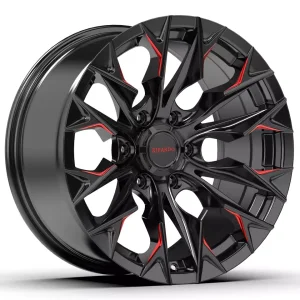
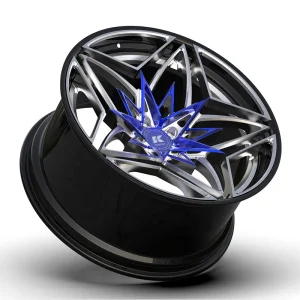
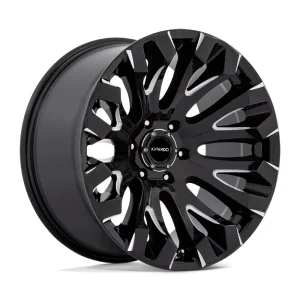
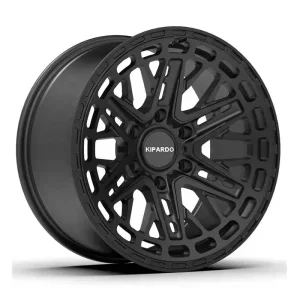
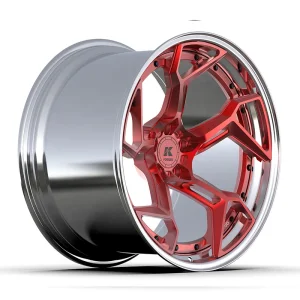
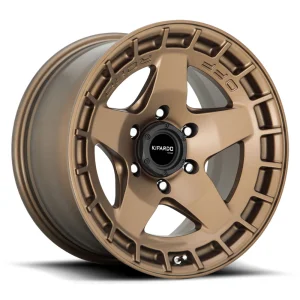
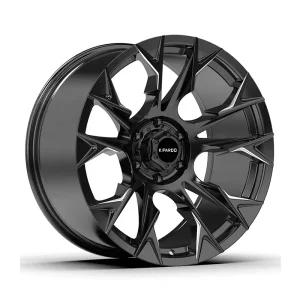
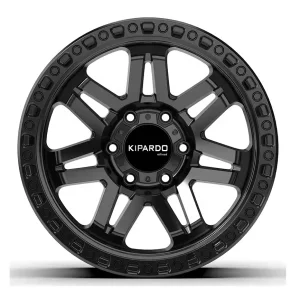
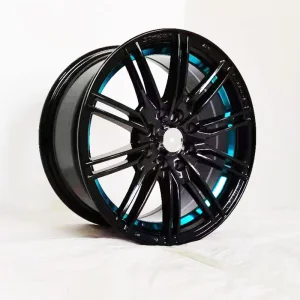
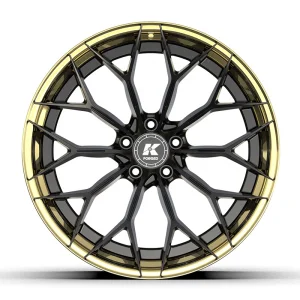
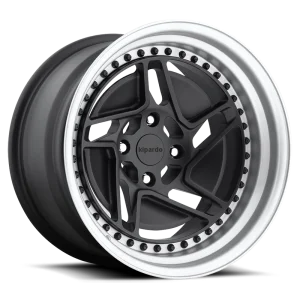
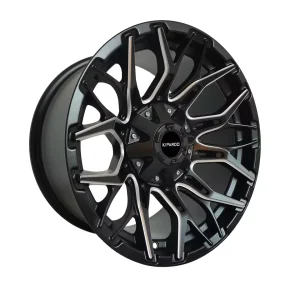
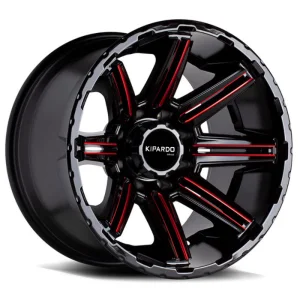
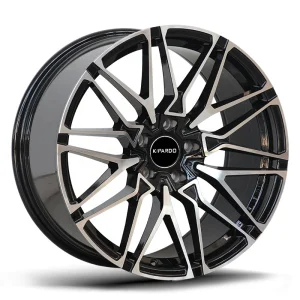
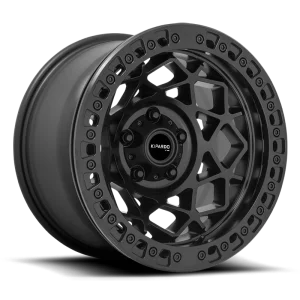
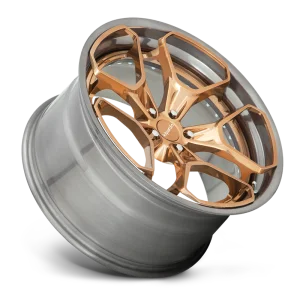
Engineered for high torsional rigidity, optimal brake-caliper clearance, and high strength-to-weight balance across demanding off-road and circuit environments.